Showing posts with label Horticulture. Show all posts

Friday, May 19, 2017

It is the Small Things

Perhaps it is because I am a plant nerd and field identification is one of my great loves that I zero in small details so much. Of course it could be wired into my DNA as I'm from a long line of people that never failed to notice or forgot anything from the tiniest details to decade old feuds. (Thankfully, I am not cursed with hanging onto grudges forever.) And so to me, "God is in the details" - it is the small stuff that means the most and always catches my eye.

On a walk through Sonnenberg you can't help but to see the big things - the Italian Garden, the Mansion, the fountains, the ponds, the Tea House, and more. They are the iconic things, the historic treasures that thousands of people come to see every year. But in my walks, those are just backdrops. I see the tiny and ever changing minutia of the gardens and Nature in general. A bit of bark on moss. A green katydid on a daylily. Dew on a leaf and the patterned spread of lichen on a rock. Each with their own amazing beauty and incredible stories to wonder at.

I urge you on your next visit to stop for a moment and look. Really look. Become fully present in that one moment of seeing. You will be amazed by what you see when you drop - or elevate - to that level of seeing. Your visits will never be the same again.

Spring 2017

Self-planted violas sprinkled with evergreen pollen

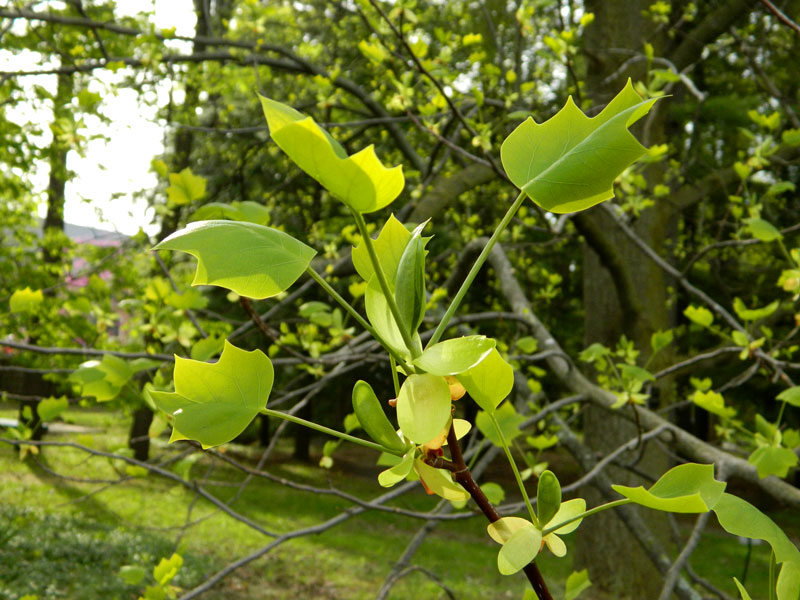
Tulip tree's young leaves reaching out

Aloe in the Greenhouse

Paper Birch bark on pine needles

Weeping beech leaves opening
and looking like tiny fans

Copper Beech with blooms hanging
like earrings
Morel mushrooms in a quiet corner
The brick walkway dusted in
pollen from the Pinetum
One final thought....

Enjoying the view? If so, bring along some young people and share looking at the tiny stuff with them. The group of you will have a whole safari of exploration and fun. And young kids are really great at this kind of seeing and will undoubtedly point out things you never saw. I'll guarantee you that priceless memories will be made by all.

Wednesday, December 7, 2016

A Sea of Flowers

Each growing season sees a veritable sea of colorful foliage and blooming plants added to our gardens. More than 10,000 are planted each spring in the Italian Garden alone -- and that is only one of the garden areas we maintain. Many of the plants we add each season are tender annuals and perennials. These are plants that cannot survive our bitter and snowy winters and so we overwinter some in our greenhouses but others we buy or grow each season to be planted when the chance of frost is past.

Italian Garden
More than 10,000 colorful annuals are planted each spring to
create the floral carpet patterns in the Italian Garden
We also plant and maintain a wide range of hardy perennial plants throughout our park. These are plants that can survive the cold winters to sprout up anew as winter looses its grip and warm days return. These include a wide range of different looks, habits, and blooming times. Some favorite perennials include roses, peonies, coneflowers, hibiscus, balloon flowers, water lilies, tulips, daffodils, lenten rose, bloodroot, and more. 

While these plants do not need special winter care to survive, they do require care throughout the growing season to keep them lush and beautiful. They will also occasionally need to be replaced as the lifespan of green plants vary widely from peonies that can span over generations (they can live to be a 100 years or more) to items like clary sage that is a biennial and dies after blooming in its second year.

Old Fashioned Garden
The Old Fashioned Garden features a wide variety of blooming
perennial plants from late spring through fall.
Our Rose Garden provides not only another sea of blooms but it perfumes the air once the roses start to bloom in mid to late June. This garden features 2500 white, red, and pink roses -- Mrs. Thompson's favorite colors. Botanically speaking, all roses are perennial shrubs as they have a main woody trunk even though most don't refer to them this way. (Only specific types of roses are generally referred to as "shrub roses.") Like all such woody plants, careful pruning is needed for best shape, health, and blooms plus other care throughout the season is required to maintain the best health and showy display. 

Rose Garden
Over 2500 rose plants are featured in our Rose Garden
Besides the flowers in our nine historic gardens, color and floral delights are all throughout the site in small corner gardens, containers, and in our arboretum. A changing tapestry of color and shapes greets every Sonnenberg guest every day.

Tulips at Sonnenberg
Spring bulbs add bright color 

While we operate in cooperation with New York State, we are not funded by the State. All gardening needs at Sonnenberg -- and there are many -- are funded through the efforts of our nonprofit organization. Your donation will help to keep the flowers blooming and growing at Sonnenberg for years to come. To make your gift, click the donate button below.


"Happiness will grow if you plant the seeds of love in the garden of hope 
with compassion and care."
- Debasish Mridha

Friday, February 6, 2015

2015 Philadelphia Flower Show


Joining Michael Warren Thomas on his 23rd annual tour to the Philadelphia Flower Show and Longwood Gardens on March 4-5, 2015? If you are, be sure to tell Michael you heard about it through Sonnenberg and he will donate $20 for each person who mentions Sonnenberg. Here are the details from Michael about the tour:

Philadelphia and Longwood Gardens Tour....

Friday, October 31, 2014

Friday, August 8, 2014

Dahlias in the Gardens

Due in part to a very generous donation from the Dahlia Society of Rochester, we have planted some of our front display gardens (the beds between Admissions and the Finger Lakes Wine Center) with beautiful dahlia plants. If you are unfamiliar with them, dahlias are tender, perennials that feature a long-lasting floral display of daisy or chrysanthemum-like flowers. They come in a wide variety of colors and forms.

We encourage you to visit and check out our dahlias. There are a variety of colors and styles but all are very photogenic as the images below can attest! In order to plan your visit, please see our website for hours and directions.

Sonnenberg Gardens DahliaSonnenberg Gardens Dahlia
 

Sonnenberg Gardens DahliaSonnenberg Gardens Dahlia


Sonnenberg Gardens DahliaSonnenberg Gardens Dahlia


Sonnenberg Gardens Dahlia


Monday, April 28, 2014

Things are Heating up in the Greenhouse


If you have visited our greenhouses recently you may have been treated to a rare sight. Our tree philodendron (Philodendron bipinnatifidum; syn. Philodendron selloum) is in bloom. Actually, more than one of them are currently in bloom. Our gardeners say they have never seen them in bloom. And many people, who keep these  as houseplants, have never either for this plant must be large in size and at least 15 - 20 years old to flower.

Philodendron bipinnatifidum flower
The flower of this plant may remind our visitors of other Araceae family members - like our native wildflower jack-in-the-pulpit (Arisaema triphyllum) - for the flower has a sheath-like bract or hood called a spathe and a fleshy stem with the flower cluster called a spadix.

Confused? They say a picture is worth a 1,000 words so check out the labeled picture to the right. Other tree philodendron flower vital stats: the flowers are typically over 1 foot long, contain about 3000 white "florets" on the spadix or stalk, and last only two days.

The tree philodendron is monoecious which means the flowers have both male and female structures. The male flowers are located on the top half of the spadix, while the middle region contains sterile male flowers, and the female flowers are located at the base. As you can see by the pictures in the gallery below, the flowers are not very showy and can be missed if not looking for them. So just how does this plant attract its pollinators?

This plant has an unusual hook for its pollinators. It has heat-producing or thermogenic flowers that when they heat up causes a pheromone to be released. This pheromone attracts Cyclocephala beetles, which are a New World scarab beetle genus. The flower then provides them with heat and nectar for two days before forcing them out (by the action of the flower closing). Covered in pollen, the beetles move onto the next flower where they pollinate it.

What is most astonishing to botanists and scientists, is that this plant can raise the temperature of the spadix to 104-113 degrees F and hold it to a constant temperature regardless of the ambient air temperature which may fluctuate from 40 - 80 degrees F. The flowers can actually feel hot to the touch. This degree of temperature regulation is unheard of in the plant world.

Be sure to visit Sonnenberg soon to see these amazing flowers for yourself. If you can't make the visit, read more below and enjoy our gallery of images at the end of this article.


References & More Study Available at:

http://biologicalexceptions.blogspot.com/2011_10_01_archive.html
http://faculty.ucc.edu/biology-ombrello/pow/Philodendron.htm
http://biologicalexceptions.blogspot.com/2011/10/is-it-hot-in-here-or-is-it-just-my.html
http://www.damninteresting.com/warm-blooded-plants/


Gallery:

Click on the images below to see the larger, full-sized image.

Philodendron bipinnatifidum
Philodendron bipinnatifidum plant & flower

Philodendron bipinnatifidum
Close up of flower

Close up of flower

New leaf unfurling 

Philodendron bipinnatifidum
Leaf scars

Philodendron bipinnatifidum
An eye-like leaf scar detail