
Monday, May 15, 2017
Learning More About the Thompsons
Archivist and Board Member, Barbara Stahl, recently did the presentation titled For the Love of Gardens: the Artistry of Mary Clark Thompson at the Naples Library. The was recorded and is included below. Enjoy!

Friday, March 24, 2017
All the Faces Looking Back at You
When you visit Sonnenberg Gardens and walk around the estate, something becomes abundantly clear: there are many sculpted faces looking back at you. So here is a bit of fun - how well do you know Sonnenberg? Can you place all these faces? These faces taken out of context makes this visual scavenger hunt deceptively difficult.
 |
| Face 1 |
 |
| Face 2 |
 |
| Face 3 |
 |
| Face 4 |
 |
| Face 5 |
 |
| Face 6 |
 |
| Face 7 |
 |
| Face 8 |
 |
| Face 9 |
 |
| Face 10 |
 |
| Face 11 |
 |
| Face 12 |
 |
| Face 13 |
 |
| Face 14 |
 |
| Face 15 |
 |
| Face 16 |
Monday, December 19, 2016
Keeping the Lights On

One of the greatest misperceptions about Sonnenberg Gardens & Mansion State Historic Park is that it is directly funded by the State of New York. It is not the State but the activities of its non-profit organization that provide the funding for everything at Sonnenberg.
- Those operational costs amount to $2500/day and those funds are needed to run the park, turn the lights on, put paper in the copier, mow the lawns, clean the bathrooms, as well as preserving the historic structures we have.
- The greenhouses alone cost $200/day to heat and our cold weather, heating season spans a 6-month period.
- During the busy garden season the tram service that helps our guests visit the site use $100 of gasoline/day.
- Even the electricity, internet service, computer, and staff time used to create this message were costs covered by the non-profit's fund-raising.

So why doesn't the State pay? The non-profit "friends" organization at Sonnenberg is proud to have achieved the highest level affiliation with the State which means all park operational needs are managed by the non-profit. That also means fund-raising is a key activity at Sonnenberg and includes collecting park admission & membership dues, applying for grants, holding special fund-raising events, renting the site for weddings, and seeking donations.
Every dollar that comes in helps to keep the park open to the public and puts new glass in our greenhouse. It also keeps flowers growing and allows you to walk through the beautiful home of Frederick and Mary Thompson. Your support and donation today to our "Share Your Love" fund will help to share Sonnenberg's beauty and history for generations to come. Click the "donate" button to make your gift.

Wednesday, December 7, 2016
A Sea of Flowers
Each growing season sees a veritable sea of colorful foliage and blooming plants added to our gardens. More than 10,000 are planted each spring in the Italian Garden alone -- and that is only one of the garden areas we maintain. Many of the plants we add each season are tender annuals and perennials. These are plants that cannot survive our bitter and snowy winters and so we overwinter some in our greenhouses but others we buy or grow each season to be planted when the chance of frost is past.
While we operate in cooperation with New York State, we are not funded by the State. All gardening needs at Sonnenberg -- and there are many -- are funded through the efforts of our nonprofit organization. Your donation will help to keep the flowers blooming and growing at Sonnenberg for years to come. To make your gift, click the donate button below.

 |
| More than 10,000 colorful annuals are planted each spring to create the floral carpet patterns in the Italian Garden |
We also plant and maintain a wide range of hardy perennial plants throughout our park. These are plants that can survive the cold winters to sprout up anew as winter looses its grip and warm days return. These include a wide range of different looks, habits, and blooming times. Some favorite perennials include roses, peonies, coneflowers, hibiscus, balloon flowers, water lilies, tulips, daffodils, lenten rose, bloodroot, and more.
While these plants do not need special winter care to survive, they do require care throughout the growing season to keep them lush and beautiful. They will also occasionally need to be replaced as the lifespan of green plants vary widely from peonies that can span over generations (they can live to be a 100 years or more) to items like clary sage that is a biennial and dies after blooming in its second year.
 |
| The Old Fashioned Garden features a wide variety of blooming perennial plants from late spring through fall. |
Our Rose Garden provides not only another sea of blooms but it perfumes the air once the roses start to bloom in mid to late June. This garden features 2500 white, red, and pink roses -- Mrs. Thompson's favorite colors. Botanically speaking, all roses are perennial shrubs as they have a main woody trunk even though most don't refer to them this way. (Only specific types of roses are generally referred to as "shrub roses.") Like all such woody plants, careful pruning is needed for best shape, health, and blooms plus other care throughout the season is required to maintain the best health and showy display.
 |
| Over 2500 rose plants are featured in our Rose Garden |
Besides the flowers in our nine historic gardens, color and floral delights are all throughout the site in small corner gardens, containers, and in our arboretum. A changing tapestry of color and shapes greets every Sonnenberg guest every day.
 |
| Spring bulbs add bright color |
"Happiness will grow if you plant the seeds of love in the garden of hope
with compassion and care."
- Debasish Mridha
Friday, November 18, 2016
Restoration - A Work in Progress
Preservation, renovation, and restoration efforts at Sonnenberg Gardens is an ever on-going activity as the estate features many structures, statues, and gardens each in need of specialized care. Over the last ten years, $4 million dollars of improvements have been made. Some improvements, like new roofing or statue cleaning, may go largely unnoticed while other work, like this year's Palm House restoration in our greenhouse complex, is hard to miss.

While we operate in cooperation with New York State, we are not funded by the State. All operational needs and restoration activities at Sonnenberg are funded through the efforts of our nonprofit organization, Your donation will go far in helping to preserve this and other historic structures at Sonnenberg which are irreplaceable treasures. To make your gift, click the donate button below.
One of the next items slated for restoration is the "Glorietta" in our Italian Garden. The Glorietta is a Garden Folly which is an eccentric or extravagant structure created as a garden or landscape decoration. The Glorietta is one of our most unique and interesting garden pieces and can be seen below.

William Hornaday in his book Masterpieces of Garden Making, published in 1917, has this to say about the Glorietta:
At the southwestern corner of the garden there rises a light and airy white marble summer house, with a domed canopy of iron grille work. I do not know what to call that feature, precisely; but it was imported from Italy, and it is the particular long-distance architectural feature of this garden. In one sense it is an informality; for it is a conspicuous side effect, balanced by nothing. Its real purpose is to carry a strong impression of artistic value clear down the length of the garden, and into its most remote corner.
Age and weather have been hard on the century-old carved marble and wrought iron components of the Glorietta. It is in need of specialized and expensive conservation care. These detailed images show some of the unique design elements as well as examples of the damage the years have caused.
 |
| Sonnenberg Glorietta |
 |
| Column Base Detail |
 |
| Column Capital Detail |
 |
| Reverse View |
 |
| Ironwork Dome |
Tuesday, November 15, 2016
2016 Volunteer Recognition

On November 6, 2016, Sonnenberg held its annual Volunteer Recognition Dinner. This dinner is meant to be a fun event where food, laughs, and stories are shared by all in recognition of the generosity and commitment of all of Sonnenberg's volunteers. More than 104 volunteers were in attendance. Key accomplishments and recognition were shared and are as follows.
Volunteers of the Year
Frank Tischer
Dolores Perkins
Frank repainted the arbor at the Belvedere this summer donating over 275 hours for this project. Dolores has been volunteering for over 15 years, the last 5 years she has been the Lead volunteer for the Rose Garden.
Volunteer Hours
Sonnenberg Volunteers shared over 18,000 hours during the 2016 season.
Milestones
Many volunteers were recognized for hitting milestones in hours volunteered.
1000 Hours
- Bonnie Cosgrove
- Charlie Gibson
- Joe Schepisi
- Mary jo Gigliotti
- Pat Quist
2000 Hours
- Bev Maves
- Judy Holcomb
- Nancy Beecher
- Rita Bavineau
6000 Hours
- Helen Myers
- Kathie Linse
 |
| 2016 Volunteers of the Year: Frank Tischer & Dolores Perkins |
Friday, September 23, 2016
There's a Mushroom House?
Even though I have visited Sonnenberg Gardens since I was young, that was what I said when I first heard of it. And while it sounds like an eclectic architectural style from the 1960's, the Mushroom House was created during the Thompsons' era at Sonnenberg for the aptly named purpose of growing mushrooms.
While its condition does not allow for tours and visits, visitors can see the exterior signs of the Mushroom House during their visit.
The entrance to the Mushroom House is located at the Gardener's Cottage, which also is the location of the Sonnenberg Administrative offices. (Access to the Mushroom House is NOT allowed.)

Skylights for this underground area were made from glass and steel and set into the ground above. They look rather like decorative manhole covers and are located next to the cafe' (on the greenhouse side). Not all of the skylights have weathered the 100+ years well and some are missing some or all of the handmade glass disks.

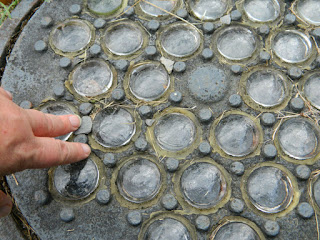

While its condition does not allow for tours and visits, visitors can see the exterior signs of the Mushroom House during their visit.
The entrance to the Mushroom House is located at the Gardener's Cottage, which also is the location of the Sonnenberg Administrative offices. (Access to the Mushroom House is NOT allowed.)


Be sure to look for this little known piece of Sonnenberg on your next visit!
Subscribe to:
Posts (Atom)